EFM is excited to relaunch our public newsletter! Each issue will bring you updates on our firm, forestland portfolio, and relevant market updates. We hope The Understory inspires you to tell others about EFM and its leadership in sustainable timber production, climate action, land stewardship, and rural economic development.
IN THIS ISSUE:
- Our Portfolio at a Glance: EFM is now over $500M AUMA
- Investment Opportunities: EFM Fund I and EFM Fund IV
- What’s New? EFM Wins FSC Leadership Award
- Forest Management: Rotation as a Part of Climate-Smart Forestry
- Learning Center: Forest Carbon Credits
- Staff Spotlight: Simon Moreira, Forest Information Systems Manager
OUR PORTFOLIO AT A GLANCE
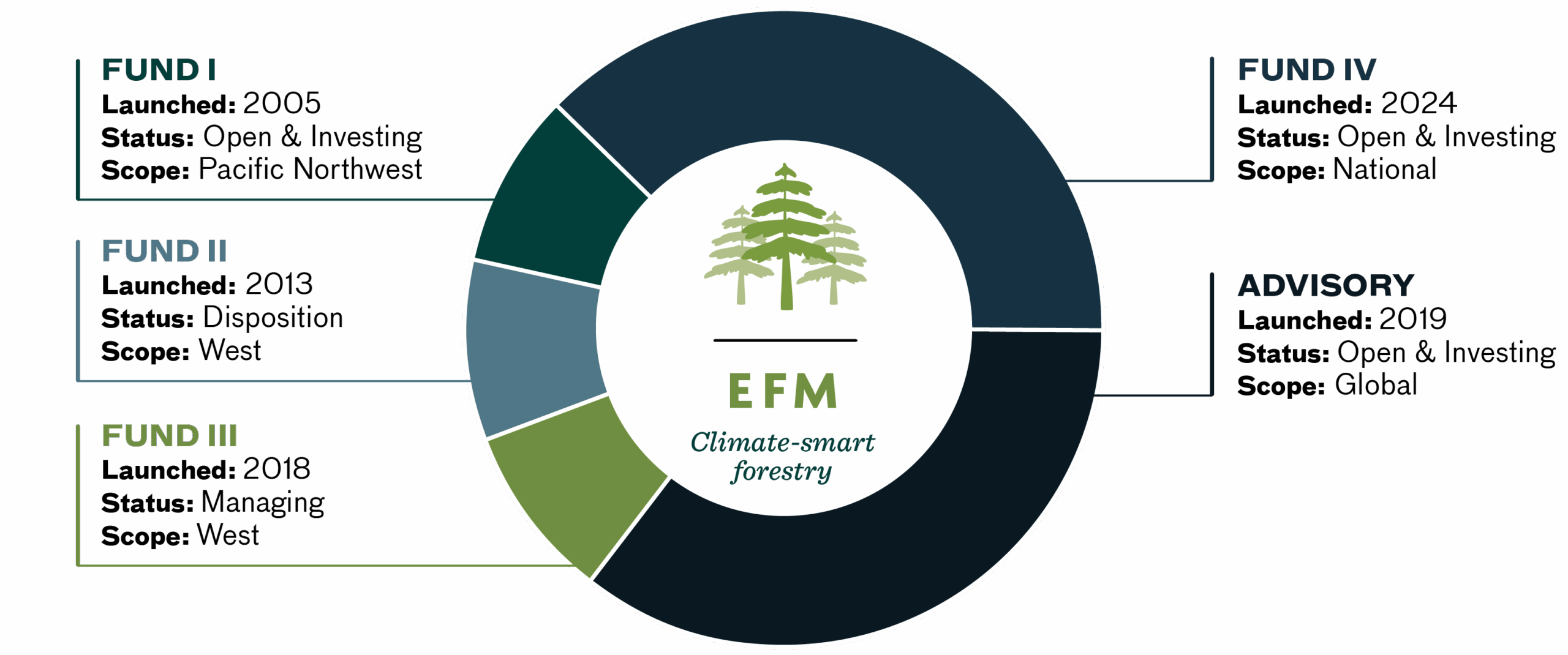
EFM has grown considerably in the last few years, illustrated by our 68,000 acre acquisition of Olympic Rainforest in late 2024. We have now passed $500 million in Assets Under Management and Advisement (AUMA), a major benchmark for a firm that started in 2005 with one property and a handful of investors.
$525M AUMA
24 Properties | 6 Exits
222,000 Acres Acquired
EFM | Climate-smart forestry
OUR PROPERTIES
INVESTMENT OPPORTUNITIES
EFM is actively raising capital.
Two EFM Funds are currently open for new investments, with the next closes scheduled for Q4 2025 and Q1 2026. These two vehicles are both managed by the same team and will create value from a combination of timber, carbon and conservation, but vary in structure, asset size and minimum investments.
EFM Fund I
- Evergreen structure since 2005
- 5 properties in Pacific NW
- Coastal temperate rainforests held indefinitely for long-term value creation and impact
- 90+ existing investors including individuals, foundations and family offices
EFM Fund IV
- Newest term fund, launched 2024
- First close complete and first asset acquired
- National scope with Western focus
- Targeting institutional investors
- Current support from foundations, corporations, family offices
WHAT’S NEW?
EFM Wins 2025 FSC Leadership Award
We’re proud to share that EFM has been honored with a 2025 Forest Stewardship Council (FSC) Leadership Award! This recognition celebrates our commitment to fish-forward, climate-smart forestry—an approach that enhances forest health, species diversity, structural complexity, and resilience, while creating lasting value for both tribal and non-tribal communities.
A heartfelt thank you to our investors, partners, stakeholders, and contractors. Your collaboration and support made this achievement possible!
FOREST MANAGEMENT
Rotation as a Part of Climate-smart Forestry
People often ask: “What is climate-smart forestry?”
At EFM, we define this approach through the 5 Rs: Rotation, Reserves, Retention, Restoration, and Relationships. These principles, developed via decades of on-the-ground experience, guide our forest management prescriptions and help us move each asset toward its Desired Future Condition (DFC).
A DFC is a planning goal that outlines the ecological, social, and financial outcomes we aim to achieve—such as ecosystem restoration, community uplift, or improved groundwater and habitat health, as well as our timber harvest plans, silviculture, and long-term financial objectives.
This summer, the principles of Rotation and Retention were on full display during a commercial thinning operation at Olympic Rainforest, EFM’s most recent and most significant property acquisition near Forks, WA.
Commercial thinning is the practice of selectively harvesting trees within a stand (a forest area with distinct characteristics), while leaving the healthiest and most promising trees to continue growing. This process improves access to essential resources like soil, light, and water, allowing the remaining trees to thrive. Like thinning seedlings in a garden bed, it reduces competition and promotes growth, increasing timber value and carbon sequestration over time. The forest ecosystem also benefits: more sunlight reaches the understory, and older, well-spaced trees develop complex structures that provide diverse habitats for wildlife.
So how does thinning relate to Rotation?
In traditional logging, forests are often clear-cut when they reach about 35 to 40 years old. This means most of the mature trees are removed all at once, and the area is replanted with seedlings. While this method can maximize revenues, it usually results in a forest made up of trees that are all the same age and species—a monoculture. These forests lack diversity and are less resilient to shocks.
An alternative is to extend the time between harvests—called the rotation period—until trees reach their maximum mean annual increment, a biological maximum, which is when their growth naturally begins to slow down. This approach can produce more valuable timber and support healthier forests, but it takes decades longer and doesn’t generate income during that time, which is why it’s not commonly used.
Thinning offers a middle ground. By letting trees grow into the 50–60+ age-class, and selectively removing some trees—especially those that would likely die from overcrowding—thinning improves growing conditions for the remaining trees. It also provides income during the extended rotation period. Over time, this leads to stronger, more diverse forests and better-quality timber, supporting both economic and environmental goals.
LEARNING CENTER
Forest Carbon Projects
EFM continues to be a leading developer of high-quality, high-impact forest carbon projects. While carbon offsets are a relatively new and complex tool in the climate change mitigation toolkit, we’re committed to helping demystify the “how” behind them.
A primer from the Oregon State University Extension Service offers a helpful overview of the forest carbon cycle (remember that?) and explains how sustainable, climate-smart forest management practices can increase carbon sequestration across the landscape. It’s a great resource for anyone looking to better understand this critical part of EFM’s revenue strategy—and the broader role forests play in climate action.
STAFF SPOTLIGHT
Meet Simon Moreira
Simon joined EFM in 2025 as the Forest Information Systems Manager after almost a decade at another company in Portland.
What are Forest Information Systems?
Trees grow—and with growth comes change. Nature is dynamic. At the Forest Information Systems department, we track changes over time to understand the current condition of our land base and to forecast future scenarios. But it’s more than just capturing data. We collect, store, process, and integrate information to meet the company’s needs, ensuring it’s delivered accurately and on time to support decision-making.
What task do you like most in your new position?
I enjoy the opportunities and challenges that come with stepping into a new role. I also appreciate the exposure to all facets of the business. This position keeps me engaged with the latest tools and systems that support informed decision-making in the forest industry.
Simon (left) educates investors during a recent EFM tour.
What’s your favorite EFM property so far?
I’m drawn to the diversity of ecosystems across our managed assets—no two forest stands are exactly alike. That said, I find the properties in the Olympic Peninsula particularly remarkable.
How did you first get interested in commercial forests?
The apple doesn’t fall far from the tree. I come from a long line of naturalists and farmers—my family has always been involved in botany or agriculture in some way. I wanted to follow a similar path, but carve out my own niche.
How do you have fun on the weekends?
Most of my social life revolves around sports and outdoor activities. I love skiing, hiking, mountain biking—and recently, I’ve started learning wing foiling. It’s a challenge since I’m not naturally a water person, but I’m enjoying it. Of course, spending time with my family is a highlight. Becoming a parent later in life has been a true blessing. Now that my daughter is a bit older, I’ve also been getting back into woodworking—a long-dormant passion I’m excited to revive.